- HOA Leaders' Brief
- Posts
- HOA Governance Maturity Model
HOA Governance Maturity Model
In partnership with


Good morning!
January always sets the tone, and I like how this team has come back focused and decisive. We’re tightening a few key systems, moving faster where it matters, and staying disciplined about what we say no to. If we keep this level of clarity, the rest of the year will compound in our favor.
— Lucas Robinson, Founder & CEO at BudgetMailboxes.com
🎯 This Week’s Strategy:
HOA Governance Maturity Model
🌐 Boardroom Brief:
When Enforcement Undermines Trust: Lessons from an Arizona HOA Fine Dispute
Strategy
🎯 HOA Governance Maturity Model
As HOAs grow more complex - facing increased regulatory scrutiny, higher homeowner expectations, and greater operational demands - strong governance becomes a defining factor of long-term success. Many associations struggle not because of finances or maintenance, but because governance practices have not evolved alongside the community. An HOA Governance Maturity Model provides a structured way for boards to assess where they are today and identify practical steps to move toward more effective, transparent, and sustainable leadership.
Rather than treating governance as a fixed set of bylaws and meeting routines, this model views governance as something that can mature over time - improving decision-making, accountability, and continuity.
How HOA Leaders Can Implement an HOA Governance Maturity Model
1. Understand the Four Stages of Governance Maturity
Most HOAs fall into one of four broad stages. Identifying your current stage is the first step.
Reactive Governance
Decisions are made in response to problems or complaints. Processes are informal, documentation is limited, and board turnover often causes disruption.Basic Compliance Governance
The board follows governing documents and legal requirements but focuses primarily on meeting minimum obligations rather than long-term strategy.Structured & Strategic Governance
Clear policies, defined roles, and standardized processes guide board actions. The board plans ahead and uses data to support decisions.High-Performing Governance
Governance is proactive, transparent, and continuously improving. Leadership succession is planned, stakeholders are engaged, and the board operates with a long-term vision.
Action Steps:
✅ Discuss these stages at a board meeting and agree on where your HOA currently sits.
✅ Identify examples that support your assessment (e.g., policy gaps, inconsistent enforcement, or lack of planning).
2. Standardize Core Governance Processes
Moving up the maturity scale requires consistency. Standardized processes reduce confusion and prevent governance breakdowns during leadership transitions.
Action Steps:
✅ Document board roles, committee responsibilities, and decision-making authority.
✅ Create written policies for enforcement, architectural review, conflicts of interest, and financial approvals.
✅ Use a shared digital repository for governing documents, policies, and historical decisions.
3. Shift from Issue-Based Decisions to Strategic Planning
Less mature boards spend most of their time reacting to immediate issues. More mature boards balance day-to-day oversight with forward-looking planning.
Action Steps:
✅ Develop an annual governance plan that includes goals beyond maintenance and budgeting.
✅ Schedule time for strategic discussions separate from regular business items.
✅ Track progress on governance goals alongside financial and maintenance metrics.
4. Strengthen Transparency and Accountability
Governance maturity is closely tied to trust. Clear communication and accountability reduce conflict and increase homeowner confidence.
Action Steps:
✅ Publish meeting summaries, decisions, and policy updates in a consistent format.
✅ Establish clear escalation paths for homeowner concerns.
✅ Conduct annual self-assessments to evaluate board performance and identify improvement areas.
5. Plan for Leadership Continuity
High-performing governance does not depend on individual personalities. It depends on systems that endure beyond any one board member.
Action Steps:
✅ Create onboarding materials for new board members.
✅ Encourage committee involvement as a leadership pipeline.
✅ Document institutional knowledge to prevent loss during board turnover.
Why It Matters
An HOA Governance Maturity Model helps boards move from “getting by” to governing with confidence and clarity. As governance matures, HOAs experience fewer conflicts, better decision-making, smoother transitions, and stronger homeowner trust. In an environment where expectations are rising and tolerance for missteps is shrinking, investing in governance maturity is one of the most effective strategies HOA leaders can adopt.
A big 2026 starts now

Most people treat this stretch of the year as dead time. But builders like you know it’s actually prime time. And with beehiiv powering your content, world domination is truly in sight.
On beehiiv, you can launch your website in minutes with the AI Web Builder, publish a professional newsletter with ease, and even tap into huge earnings with the beehiiv Ad Network. It’s everything you need to create, grow, and monetize in one place.
In fact, we’re so hyped about what you’ll create, we’re giving you 30% off your first three months with code BIG30. So forget about taking a break. It’s time for a break-through.
Boardroom Brief
When Enforcement Undermines Trust: Lessons from an Arizona HOA Fine Dispute
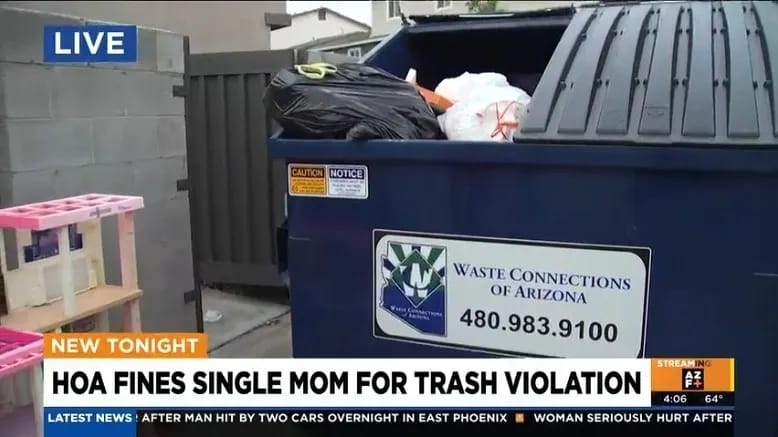
A recent incident in Surprise, Arizona - where an HOA fined a resident $150 after identifying her via a receipt found in a trash bag left beside an already-overflowing dumpster offers a timely reminder of how enforcement practices can impact community trust. While the association stated the fine was meant to discourage violations and recoup enforcement costs, residents reported chronic dumpster overflows despite twice-weekly pickups, raising questions about fairness and proportionality. For HOA leaders, this case underscores the importance of aligning enforcement with operational realities: ensuring adequate waste capacity, applying discretion for first-time or unavoidable violations, and providing clear dispute processes. Strict rule enforcement without contextual judgment may resolve a violation on paper, but it can erode goodwill and expose boards to reputational and governance risks within their communities.
Game
🎉 Fun Finale: Play & Poll
When a rule violation occurs due to an operational issue (such as an overflowing dumpster), how should an HOA respond?(Tap on your answer) |
 Real workflows. Real results | Curious About Agentic AI?A FREE community where agentic AI workflows are built and shared. |
Last Time the Market Was This Expensive, Investors Waited 14 Years to Break Even

In 1999, the S&P 500 peaked. Then it took 14 years to gradually recover by 2013.
Today? Goldman Sachs sounds crazy forecasting 3% returns for 2024 to 2034.
But we’re currently seeing the highest price for the S&P 500 compared to earnings since the dot-com boom.
So, maybe that’s why they’re not alone; Vanguard projects about 5%.
In fact, now just about everything seems priced near all time highs. Equities, gold, crypto, etc.
But billionaires have long diversified a slice of their portfolios with one asset class that is poised to rebound.
It’s post war and contemporary art.
Sounds crazy, but over 70,000 investors have followed suit since 2019—with Masterworks.
You can invest in shares of artworks featuring Banksy, Basquiat, Picasso, and more.
24 exits later, results speak for themselves: net annualized returns like 14.6%, 17.6%, and 17.8%.*
My subscribers can skip the waitlist.
*Investing involves risk. Past performance is not indicative of future returns. Important Reg A disclosures: masterworks.com/cd.